Preventing Slips, Trips and Falls in the Workplace


Key Takeaways
- Slips, trips and falls (STFs) in the workplace are some of the top causes of workers compensation claims. STFs are some of the most common and costly workplace safety risks but also some of the most preventable.
- The first step toward slip, trip and fall prevention is identifying fall hazards at work and taking steps to create safe passage for employees and visitors.
- Building a strong safety culture is one of the top ways for companies to help prevent slips, trips and falls in the workplace and reduce workers compensation claim costs.
- When a slip-and-fall incident does occur, an effective response that includes return-to-work strategies can help prevent future incidents and lower workers compensation claim costs.
Slips, trips and falls: A persistent workplace risk
Slips, trips and falls (STFs) happen daily at businesses, from grocery stores to factories to hotels and retail shops. In fact, STFs are some of the most frequent and costly types of workplace injuries facing companies today.
STFs are among the most frequent workplace injuries and a leading cause of days away from work. The median number of lost workdays for a slip, trip or fall is 10, and nearly 38% of days away from work cases involve slips, trips and falls.1 These incidents also lead to some of the more costly workers compensation claims, averaging $54,499 per claim, according to National Council on Compensation Insurance data cited by the National Safety Council.2 Because slips, trips and falls frequently result in injuries that require time off and medical attention, they can have a significant impact on a company’s overall claim costs.
Companies can take steps to help prevent and reduce slip-and-fall injuries and lower workers compensation costs. Preventing slips and trips is an important part of a solid premises security and liability management plan for a company.
The alarming reality of slip, trip and fall accidents
Workplace slip, trip and fall incidents may seem minor, but they represent one of the most frequent and costly safety challenges facing organizations today. Understanding the scope of this problem is the first step toward creating effective prevention strategies that protect a company’s workforce and bottom line.
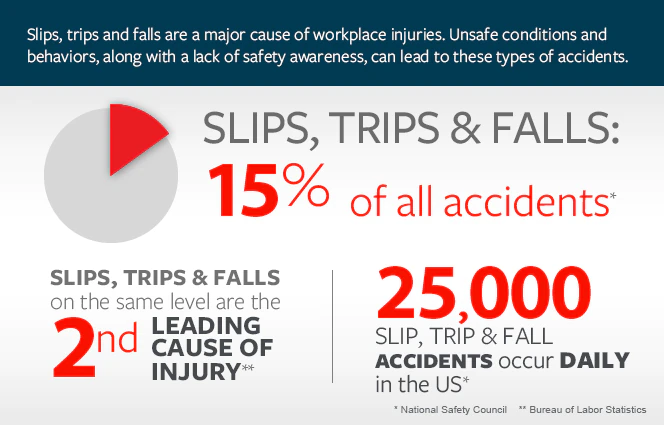
Slips, trips and falls are a major cause of workplace injuries. Unsafe conditions and behaviors, along with a lack of safety awareness, can lead to these types of accidents.
Slips, trips and falls: 15% of all accidents*
Slips, trips and falls on the same level are the 2nd leading cause of injury**
25,000 slip, trip and fall accidents occur daily in the US*
*National Safety Council
**Bureau of Labor Statistics
Common causes of workplace slips and falls
Learning the common causes of slips, trips and falls at work can help prevent these incidents and associated injuries. Common fall hazards at work include:
- Cluttered walkways, indoors or outdoors.
- Slippery flooring surfaces (e.g., glossy tile, polished stone, newly waxed floors).
- Loose surfaces (e.g., gravel or loose flooring).
- Wet/slippery floors, steps, ramps or walkways, inside or outside (from spills, leaks, rain, snow, ice or mud).
- Leaves or plant debris on walkways.
- Uneven walking surfaces (e.g., a broken sidewalk, a curled rug or a cord across a walkway).
- Steps or ramps that lack signage.
- Steps or stairways that are poorly lit, uneven or missing secure handrails.
Identifying fall hazards at work and putting in place prevention and response strategies are essential steps toward creating a safer workplace.
Slip, trip and fall prevention strategies
Every company can work toward preventing slips, trips and falls in the workplace. These measures range from footwear requirements to “slippery floor” or “step down” signage to employee training on trip-and-fall prevention.
10 ways to help create safer walking areas and prevent slips, trips and falls at work:
- Start with entryways, installing nonslip mats and making sure they are properly secured.
- Check all walkways inside and outside the building for issues that need repair, such as broken, slippery or uneven surfaces.
- Make premises walk-throughs a regular part of your routine, using a slip-and-fall prevention checklist to identify potential hazards.
- Check interior and exterior lighting, making upgrades if necessary for better visibility.
- Make clutter prevention a priority, identifying any objects that obstruct pathways and putting training, policies and systems in place to keep walkways clear.
- Take note of areas with slick flooring and employ slip-resistant floor treatments.
- Create spill cleanup stations around the premises and make fast spill cleanup a priority.
- Use signage to alert employees and customers to a wet floor, step-down and other hazards.
- Require proper footwear in the workplace.
- If a slip-and-fall incident occurs, document it, investigate and file a report as quickly as possible to determine the cause and prevent future accidents.
These prevention strategies can help reduce the risk of costly slips, trips and falls and decrease the number of workers compensation insurance claims and lost-time injuries at a company.
Three ways to help prevent workplace slip, trip and fall injuries
Slip, trip and fall accidents are often the result of preventable hazards and unsafe conditions rather than random occurrences. By taking proactive steps to identify risks and maintain safe work environments, you can significantly reduce these incidents and protect employees from injury.
- Eliminate common hazards.
- Create safe passageways.
- Report and analyze all incidents.
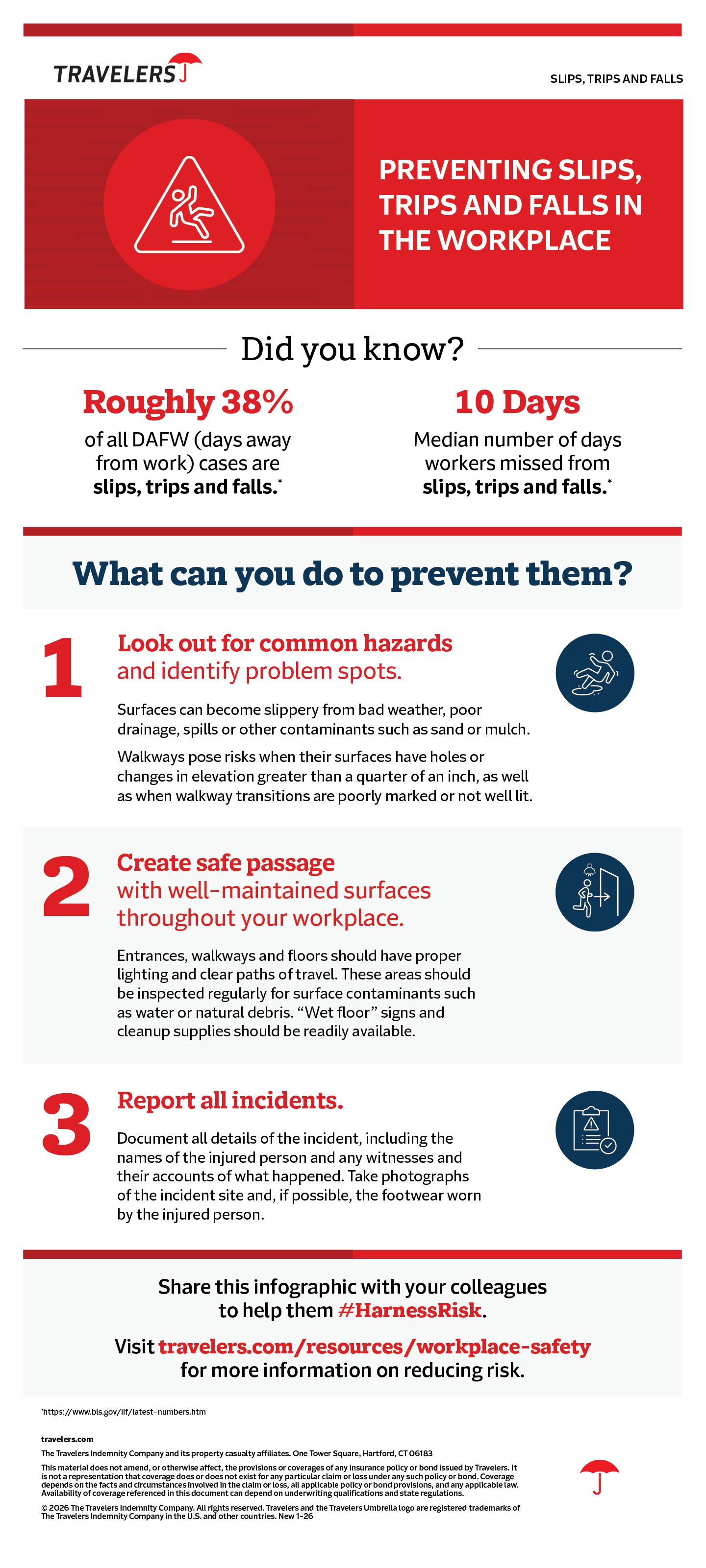
Preventing Slips, Trips and Falls in the Workplace
Did you know?
Roughly 38% of all DAFW (days away from work) cases are slips, trips and falls.*
10 Days Median number of days workers missed from slip, trips and falls.*
What can you do to prevent them?
1. Look out for common hazards and identify problem spots.
Surfaces can become slippery from bad weather, poor drainage, spills or other contaminants such as sand or mulch.
Walkways pose risks when their surfaces have holes or changes in elevation greater than a quarter of an inch, as well as when walkway transitions are poorly marked or not well lit.
2. Create safe passage with well-maintained surfaces throughout your workplace.
Entrances, walkways and floors should have proper lighting and clear paths of travel. These areas should be inspected regularly for surface contaminants such as water or natural debris. "Wet floor" signs and cleanup supplies should be readily available.
3. Report all incidents.
Documents all details of the incident, including the names of the injured person and any witnesses and their accounts of what happened. Take photographs of the incident site and, if possible, the footwear worn by the injured person.
Share this info graphic with your colleagues to help them #HarnessRisk.
Visit travelers.com/resources/workplace-safety for more information on reducing risk.
* https://www.bls.gov/iif/latest-numbers.htm
travelers.com
The Travelers Indemnity Company and its property casualty affiliates. One Tower Square, Hartford, CT 06183
This material does not amend, or otherwise affect, the provisions or coverages of any insurance policy or bond issued by Travelers. It is not a representation that coverage does or does not exist for any particular claim or loss under any such policy or bond. Coverage
depends on the facts and circumstances involved in the claim or loss, all applicable policy or bond provisions, and any applicable law. Availability of coverage referenced in this document can depend on underwriting qualifications and state regulations.
© 2026 The Travelers Indemnity Company. All rights reserved. Travelers and the Travelers Umbrella logo are registered trademarks of The Travelers Indemnity Company in the U.S. and other countries. New 1-26
Reporting and root cause analysis
Putting a system in place to report incidents and track hazards is key to preventing slips, trips and falls in the workplace. Meticulously documenting and reporting slip-and-fall incidents can help you avoid future occurrences and provide important evidence if a workers compensation claim is filed. Conducting a root cause analysis can help identify the underlying causes of fall incidents and support strategies to prevent future occurrences, as shown in healthcare settings.3 Hazard tracking and slip-and-fall prevention checklists also are important tools to support ongoing risk mitigation.
How to address slip-and-fall risks year-round
Slips, trips and falls can happen indoors and outdoors, in every season. While there are seasonal slip-and-fall risks, especially in winter, it’s helpful to address these as part of a year-round slip-and-fall prevention plan.
Winter-specific risks include slips on ice, safety hazards related to snow on walkways and wet entryways caused by rain, snow and slush tracked in by customers and employees.
Here's how to address slip-and-fall risks across outdoor areas, indoor entryways and winter-specific conditions as part of a cohesive safety strategy.
Outdoor areas: sidewalks, parking lots and entrances
Outdoor slip prevention is a key part of creating a safer workplace, in winter and throughout the year. A slips-on-ice safety strategy involves creating a plan for routine de-icing, snow removal and surface treatments, prioritizing parking lot safety and safe walkways. Consider upgrades to exterior lighting for better visibility, which is especially important during winter, when it gets dark outside earlier in the day. Finally, create a storm plan and review it yearly.4
Indoor areas: entryways and transitional spaces
Indoor slip prevention is an equally important factor in workplace safety. Focus on entryway safety, as moisture can collect near the entrance to a business during rainy or snowy weather. Creating a safe entryway includes the use of nonslip mats and drying stations. It’s also important to put in place proper cleaning protocols, including mopping up water that collects near doors in rainy, slushy or snowy weather and utilizing hazard signage while these areas are drying.
Winter-specific slip-and-fall risks
Winter slip, trip and fall prevention is another important element of workplace safety, especially for businesses in climates where winter storms occur regularly. Ice, snow and sleet commonly cause increased slips, trips and falls in the winter. It’s important to create and implement a written snow-and-ice removal plan that includes details on who is responsible for these tasks (e.g., in-house maintenance staff or a contractor), frequency of removal, use of salt or sand, and how logs will be used to document these activities. Logs should include detailed information such as dates, times, snow accumulation, temperature and action taken (e.g., plowing snow, applying salt).5
Build a safety culture: Train employees.
Creating a safety culture is key to preventing slips, trips and falls in the workplace. A workplace safety culture requires getting buy-in from everyone in the company, starting with top leadership. Training employees to identify and report fall hazards in the workplace to management is crucial for preventing incidents and avoiding injuries. For example, fatigue may impair awareness and contribute to preventable slips or missteps on the job.
Employees should understand and commit to the importance of reporting any incidents that occur, in accordance with the guidelines outlined in the company’s premises security and liability management plan. A robust safety culture that includes an engaged workforce is key to reducing workers compensation claims.6
Fall injury response preparedness
Even with the best prevention efforts, workplace fall injuries may still occur. It’s essential to have an injury response protocol that enables quick, appropriate responses and proper incident documentation and helps reduce workers compensation costs.
An effective injury response protocol may include the following7:
- Provide first aid to the injured employee immediately.8
- Document all details on a standard incident report form.
- Interview injured parties and witnesses to get their detailed accounts.
- Take photos of the location where the incident occurred. These can provide valuable clues to what went wrong and how similar incidents can be prevented.
- Have a post-incident meeting for management to review details and make any necessary changes to the premises or employee training to prevent similar incidents in the future.
- Have a recovery support protocol that includes return-to-work programs, which can reduce lost time and claim costs.
Consider using Travelers Risk Control slip, trip and fall prevention services. These services help assess risks, develop prevention strategies and provide training on building a safety culture to help prevent slip-and-fall accidents. Travelers risk professionals can help businesses create injury response protocols and strategies designed to reduce workers compensation claim costs.
A strong workplace safety culture and a solid prevention strategy are the keys to slip, trip and fall prevention. Travelers Risk Control can be a strategic advantage to businesses that value risk and workers compensation claim management.
To access Risk Control specialists who can help businesses build safer workplaces and reduce workers compensation claim costs, speak with a Travelers insurance agent today.
Sources
1 https://www.bls.gov/iif/latest-numbers.htm
2 https://injuryfacts.nsc.org/work/costs/workers-compensation-costs
3 https://pmc.ncbi.nlm.nih.gov/articles/PMC11211207/
4,5 https://www.wsps.ca/resource-hub/articles/slips-trips-and-falls-6-ways-to-combat-winter-hazards
6 https://www.sciencedirect.com/science/article/pii/S092575352300351X
7 https://safetyculture.com/topics/incident-report/injury-reporting
8 https://www.osha.gov/sites/default/files/OSHA-RK-Forms-Package.pdf